




How to Set Up Elakai Horseshoes
1. The Playfield
- Place the two stakes 40 feet apart.
- Stakes should extend 14–15 inches above the pit surface.
- Stakes may lean slightly toward each other, but no more than a 3-inch incline.
- Stakes should be solid or hollow steel, 1 inch in diameter.
- Each stake should be at least 21 inches from both the front and back of the pit.
- Pits are constructed:
- 31–36 inches wide, and
- 43–72 inches long.
- If the pit is smaller than the maximum size, fill the extra space between the pit and backboard with the same material as the platforms and level it with the pit and platforms.
- The stake is placed at the center of the pit.
- Ideal pit filler is clay, which must be watered periodically to maintain texture.
- Sand, sawdust, or loose soil are also commonly used, as long as they reduce bouncing.
- The filler depth should be at least 4 inches, with 8 inches recommended.
- A foul line is marked 3 feet in front of each stake, creating:
- A standard throwing distance of 37 feet (foul line to opposite stake).
- For short-distance pitchers, a foul line 27 feet from the opposite stake.
2. The Backboards (Recommended for Serious Play)
Backboards are not included, but recommended for more serious or competitive play.
- Place backboards at least 4 feet behind the stake.
- Backboards should be at least 1 foot high and extend the full width of the pit.
3. The Horseshoes
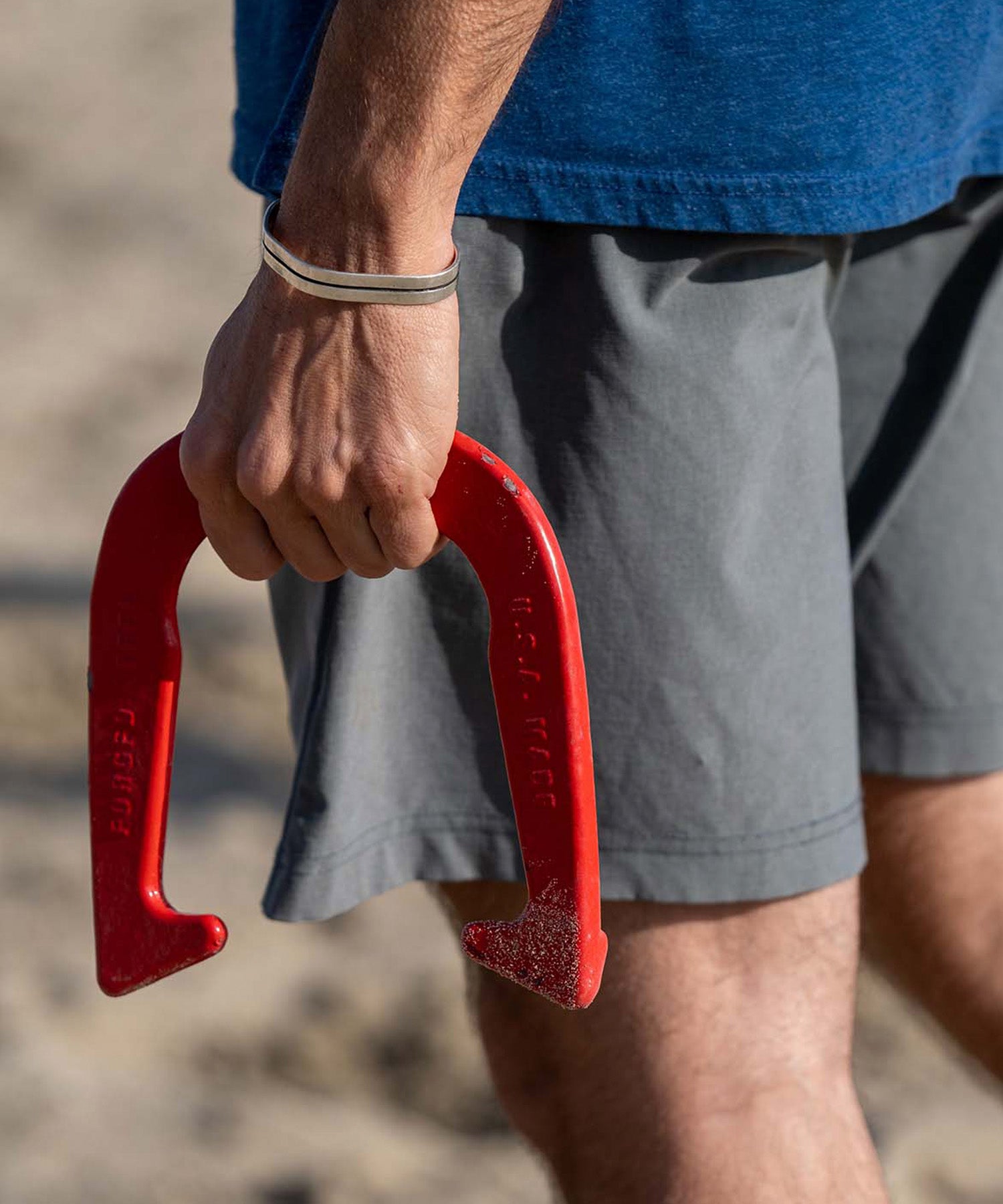
- Each horseshoe must not weigh more than 2 lbs, 10 oz.
- Maximum width: 7 1/4 inches.
- Maximum length: 7 5/8 inches.
- On a line parallel and 3/4 inch from a straightedge touching the shoe’s points, the opening must not exceed 3 1/2 inches.
How to Play Horseshoes
The Rules
- The first player throws their two horseshoes, one after the other.
- The second player then throws their two horseshoes.
- When pitching, a player must not cross the foul line before releasing the shoe.
- Games can be played:
- To 40 points (point limit game), or
- To 40 shoes (shoe limit game, each player throws 40 shoes in total).
- In a shoe limit game, the player with the highest score at the end wins.
- If there is a tie:
- Each player may take a half win, or
- Play a two-inning tiebreaker to determine the winner.
The Scoring
To score any points, shoes must be a leaner, a ringer, or be the closest shoe to the stake.
-
Ringers (3 points each)
- A ringer completely encircles the stake.
- A straightedge laid across the open ends of the shoe must not touch the stake.
- Each ringer is worth 3 points.
-
Leaners (1 point each)
- A leaner is a shoe that comes to rest leaning against the stake, or within about 6 inches (one horseshoe-width) of it.
- Each leaner is worth 1 point.
-
Closest Shoe
- If no ringers are thrown, the player with the shoe closest to the stake scores 1 point.
- If one player has both shoes closer than any of the opponent’s, that player scores 2 points.
-
Combination Scoring
- If you have the closest shoe and a ringer, you score 4 points.
- If your opponent throws a ringer on top of your ringer, the ringers cancel and those points are not counted.
- If your opponent throws a single ringer and you throw two ringers, you score 3 points (for the extra ringer).
- Leaners do not cancel each other out.
Safety & Precautions
WARNING: When using this product, basic safety precautions should always be followed to reduce the risk of personal injury and equipment damage. Read all instructions before use.
-
Keep children away.
- Children must never be in the work area during court building and setup.
- Children must be closely supervised by a responsible adult while playing horseshoes.
-
Observe work area conditions.
- Use caution to avoid underground electrical lines, water lines, telephone lines, etc., when driving stakes into the ground.
-
Be alert.
- Horseshoes are heavy and can be dangerous when thrown.
- Never throw near people or animals.
- All competitors must be well clear of the pit when another competitor is pitching.
-
Store idle equipment.
- When not in use, store horseshoes in a dry location to help prevent rust.
-
Use the right product.
- Do not modify this product.
- Do not use it for any purpose other than its intended use.
-
Inspect before use.
- Before using, check all components for damage.
- Do not use any part that appears damaged or unable to perform its intended function.
- Repair or replace damaged parts before playing.
-
Use proper replacement parts.
- When servicing, use only identical replacement parts.
- Use of other parts may void the warranty.
-
Do not use under the influence.
- Do not assemble or use the product if under the influence of alcohol or drugs.
- If taking prescription medication, read all warnings to ensure your judgment and reflexes are not impaired.
- If there is any doubt, do not use the product.
-
Keep components dry & secured.
- Store components in a dry location and out of reach of children.
- For player safety, if stakes remain in the ground when not in use, it is recommended to cap them with a plastic end cap or conduit cap.