





How to Set Up Elakai Croquet
1. Getting Started
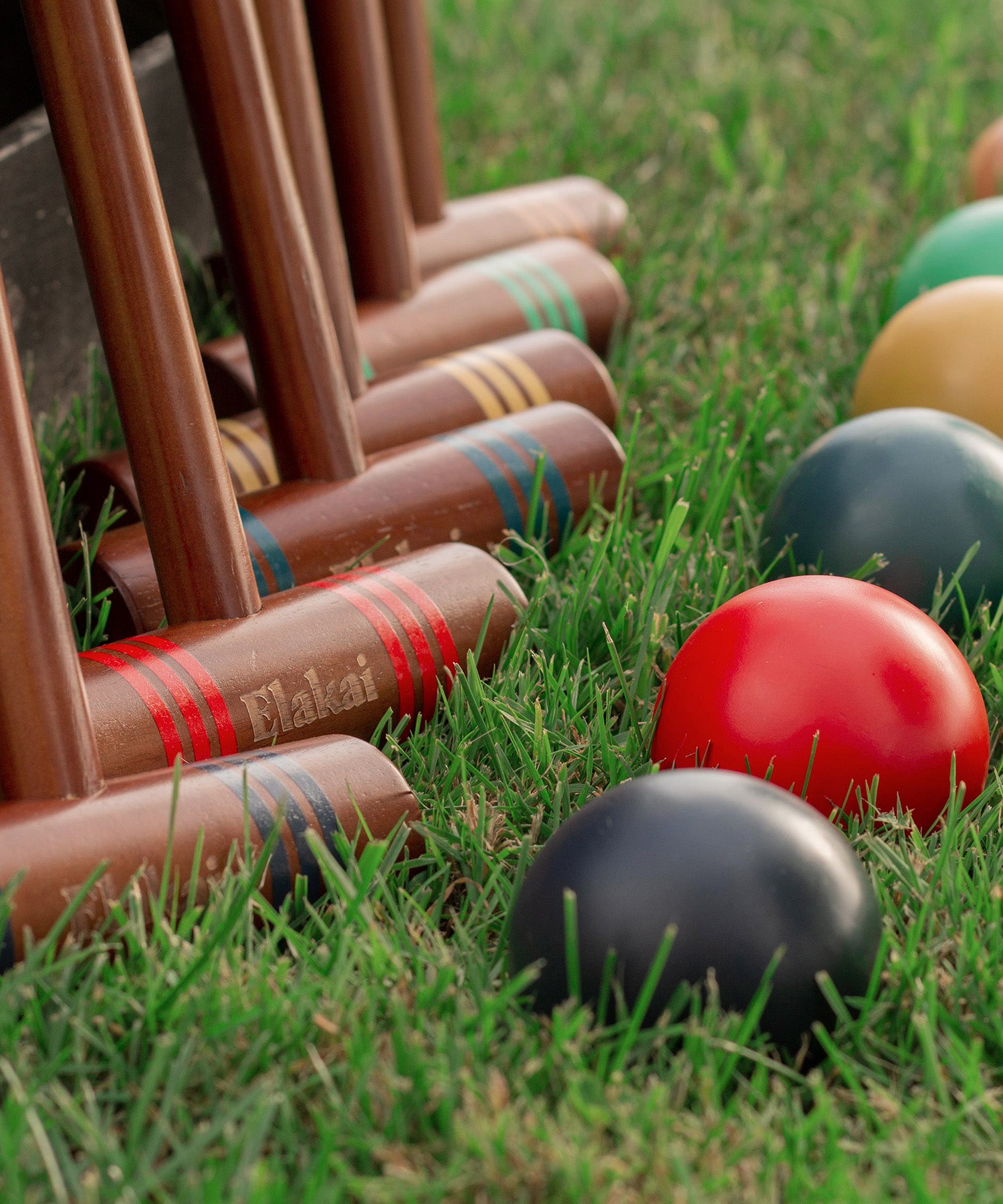
- Remove the wickets, mallets, stakes, and balls from the carry bag.
- Find a flat, open space and place the wickets and stakes into the ground in your desired layout.
- Clear away any objects between or around the wickets and stakes so nothing interferes with play.
- Match each mallet to its corresponding ball color.
- You’re now ready to play Elakai Croquet!
The Playfield
- A standard croquet court is 100 ft x 50 ft.
- When playing with house rules or in smaller yards, the court can be any size that fits your space and still allows a clear course through the wickets.
How to Play Nine-Wicket Croquet
General Overview
The goal is to maneuver your ball through the full course of wickets in the correct order and direction, then hit the finishing stake. The first team to have all of its balls complete the course and hit the finishing stake wins.
- A play is made when the ball is struck with a mallet.
- The player taking a turn is the striker, and their ball for that turn is the striker ball.
- Turns are typically taken in the same sequence throughout the game.
- Each turn begins with one stroke, but the striker can earn extra strokes by hitting another ball (roquet) or scoring a wicket or stake point.
- The striker ball may hit and move other balls to score points, but the striker must never hit another ball directly with the mallet.
Starting the Game
- Form two teams of 1, 2, or 3 players per team.
- Once teams are decided, flip a coin to determine which team plays first.
- The game starts with each player’s ball placed halfway between the finishing stake and wicket #1.
Wicket Points
- When a ball passes through a wicket in the correct direction and in the correct sequence, that team earns a wicket point for the striker.
Hitting Other Balls (Roquet & Croquet)
- At the start of a turn, all balls are considered live.
- If the striker ball hits another live ball, it has made a roquet.
- After a roquet, the striker may take croquet from the roqueted ball in one of four ways:
- Two Extra Strokes: Leave the striker ball where it lies and take two extra strokes.
- Ball-to-Ball Croquet: Place the striker ball in contact with the roqueted ball and strike the striker ball.
- Nine-Inch Placement: Place the striker ball within 9 inches of the roqueted ball and strike the striker ball.
- Foot Croquet: Place the striker ball next to the roqueted ball, hold the striker ball with your foot, and strike it.
- The croqueted ball becomes dead and remains dead until:
- The striker ball scores a wicket or stake point, or
- The next turn begins.
- If the striker ball hits a dead ball, it does not count as a roquet and no extra strokes are awarded.
Boundaries
- Boundaries can be marked with flags, string, chalk, or not marked at all, depending on house rules and available space.
Points & Combined Actions
- If the striker ball scores both a wicket point and a roquet on the same stroke, only one action or point is counted according to the rules in play.
Turning Stake
- A point is scored when the ball hits the turning stake in the correct sequence.
Continuation Strokes
- The striker earns extra strokes by:
- Scoring a wicket,
- Hitting the turning stake, or
- Taking croquet.
- Extra strokes are always played from where the ball lies.
- If the striker ball makes a roquet while already taking croquet, no extra strokes are awarded from that roquet; the striker simply takes croquet from the ball just roqueted.
- If the striker ball scores both a wicket point and a turning stake point on the same stroke, only one extra stroke is awarded.
- The only time two extra strokes can be awarded is when the striker ball scores two wicket points on one stroke. The second extra stroke is forfeited if the first extra stroke scores a wicket, stake, or roquet point.
Rover Balls & Scoring the Finishing Stake
- A rover ball is a ball that has scored all of its points except for the finishing stake.
- When a rover ball hits the finishing stake, it has scored out and is removed from the game.
- Play continues until one entire team has all of its balls come into contact with the finishing stake.
- The striker ball cannot score the finishing stake and make a roquet on the same stroke; whichever happens first is counted.